Classic & Modern — a site theme
For developers who can build anything and would rather not design it
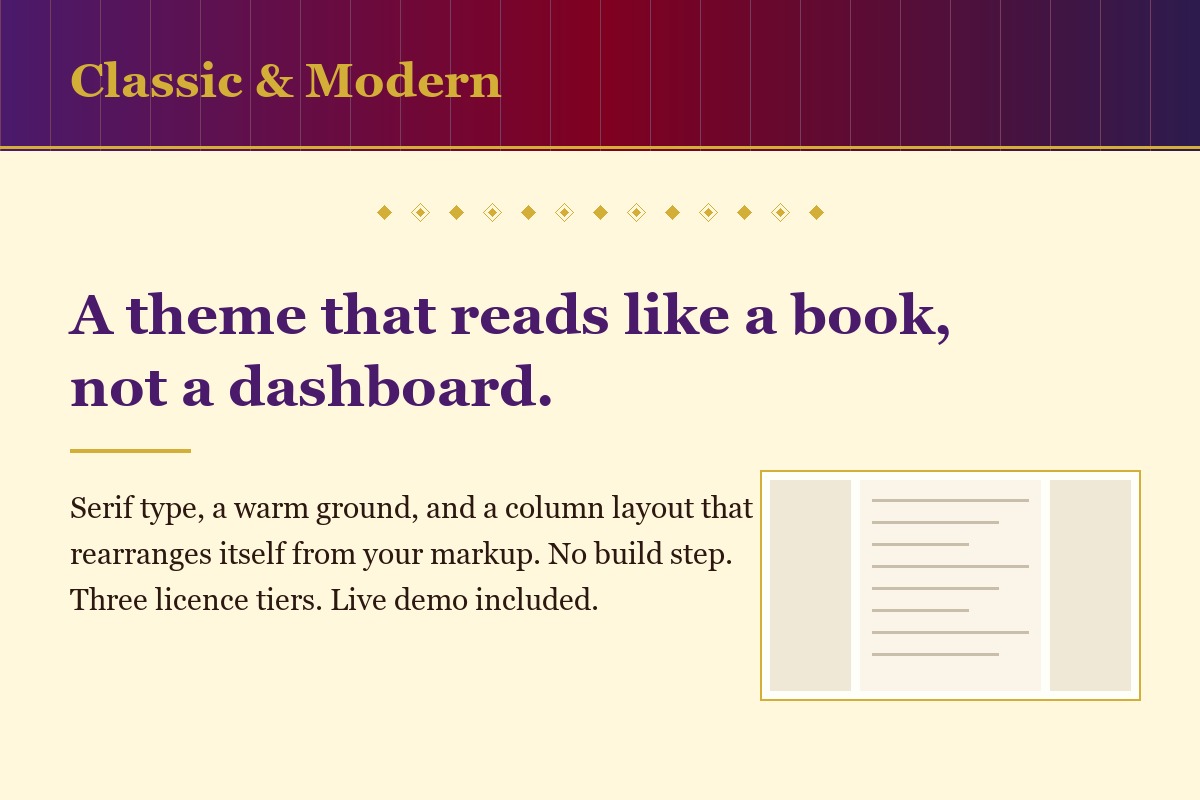
Most template libraries offer you the same flat sans-serif SaaS look, and using one quietly announces that nobody paid for design. This is the other thing: a warm, editorial treatment built on serif type and a deep gradient masthead — closer to a well-set book than a dashboard. It's the design running behind ThaiBridge AI, which you can open and scroll right now.
Why it’s worth paying for
- A look you couldn't have produced yourself. Most developers know their design is the weak part and can't fix it by trying harder. This is taste you can buy, not a grid you still have to make attractive.
- Never writing column CSS again. The layout detects what each page contains and becomes one, two or three columns on its own. Add a sidebar and it reflows. Remove it and it reflows back. You write no media queries for it.
- The mobile work already done. Every component has been through real use on real phones, including the sticky sidebar and the menu — the two things that usually break first.
- Rebranding in minutes, not a weekend. Every colour comes from one file. Change a handful of values and the whole site follows, including hover, focus and border states you'd otherwise hunt down one by one.
See it before you buy it
Open the live demo → Five pages, four different layouts, and a second colourway — all of it the theme with nothing custom added. Click through it properly; that is what you are buying.
What is in the download
- Five HTML pages, each showing a different layout
- theme.css — the whole theme, one file, 33 colour tokens
- colourway-slate.css — a second identity as a worked example
- theme.js — menus and collapsible sections, keyboard accessible
- A START-HERE guide, README, changelog and licence
How to use it — the ten steps
The first three have nothing to do with the theme, and they are half the job.
How the job goes
- Decide what the site is for — who it is for, and what you want a visitor to do.
- Plan your pages. Five or six is plenty. That list becomes your menu.
- Gather your content first — the words for each page, your photos, your logo, two or three brand colours.
- Open index.html and click through the demo. Notice which layout suits each of your pages.
- Copy the folder and rename it after your site. Leave the original untouched.
- Keep the pages you need, delete the rest, duplicate one for any extra.
- Swap the words and pictures, one page at a time. Home first.
- Change the site name and the colours. One block at the top of theme.css controls the colours for every page.
- Open every page, click every link, try it on your phone.
- Upload the folder to any web host. Nothing to install.
Stuck on any step? Email support is included for 60 days. And if you would rather not do steps 5 to 10 at all, installation on your domain starts at £150.
What it isn't: a page builder, a CMS or a component framework. It's HTML and CSS you edit by hand — which is why there's no build step and nothing to keep updated. If that's not how you want to work, I'll install and customise it for you instead.